Key Sections
The U.S. Senate voted on September 15, 2026, on a procedural motion to invoke cloture on the Digital Asset Market Clarity Act (CLARITY Act). Falling short of the 60-vote supermajority required to overcome a filibuster and limit floor debate, Senate leadership was unable to advance the revised 635-page market structure draft toward a final floor vote.
The procedural failure delays federal market-structure legislation until at least 2027, with key sponsors warning that without near-term momentum, comprehensive market rules could remain paused until as late as 2030.
What Is the CLARITY Act?
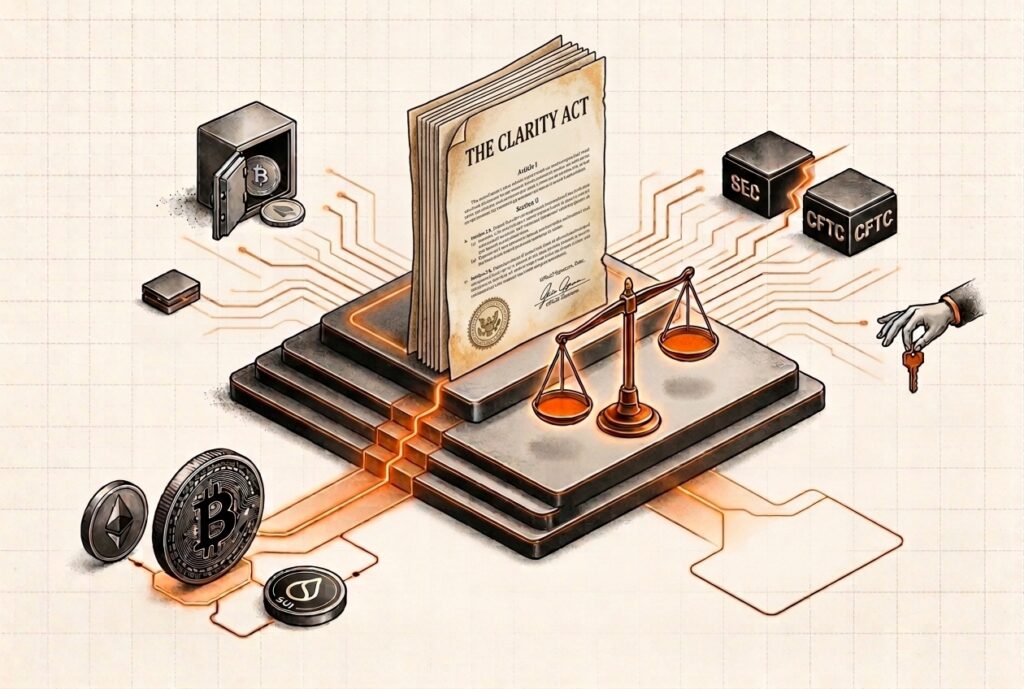
The CLARITY Act (formally the Digital Asset Market Clarity Act) is a federal bill designed to end more than a decade of regulatory ambiguity over how digital assets are classified and overseen. Its core provisions:
- Splits jurisdiction between regulators: the CFTC would get exclusive authority over “digital commodities,” while the SEC would retain authority over “digital securities.”
- Defines a legal test for when a token is “sufficiently decentralized” to count as a commodity rather than a security, with Bitcoin and Ethereum explicitly classified as commodities.
- Sets registration and operating requirements for crypto exchanges, brokers, and dealers, plus consumer-protection, anti-money-laundering, and disclosure standards.
- Affirms the right of individuals to self-custody digital assets, a provision the industry pushed hard for.
Which Altcoins Already Have Regulatory Clarity
Here’s something that gets lost in the vote-count coverage: regulators have already started answering the classification question, with or without the CLARITY Act. In March 2026, the SEC and CFTC issued a joint classification naming 17 digital assets as “digital commodities”, placing them outside securities law and under CFTC oversight:
| Asset | Ticker |
|---|---|
| Bitcoin | BTC |
| Ethereum | ETH |
| XRP | XRP |
| Solana | SOL |
| Cardano | ADA |
| Chainlink | LINK |
| Avalanche | AVAX |
| Polkadot | DOT |
| Stellar | XLM |
| Hedera | HBAR |
| Litecoin | LTC |
| Dogecoin | DOGE |
| Shiba Inu | SHIB |
| Tezos | XTZ |
| Bitcoin Cash | BCH |
| Aptos | APT |
| Algorand | ALGO |
Why the Procedural Vote Stalled
The cloture vote filed by Senate Majority Leader John Thune required a bipartisan consensus to reach 60 votes. With Republicans holding 53 Senate seats, proponents needed at least 7 Democratic votes to proceed. Despite final revisions released prior to the vote, including updated ethics provisions, state attorney general enforcement tools, and Treasury circuit breakers for payment stablecoins, a coalition of opposing senators and industry pushback prevented the bill from advancing.
Immediate Legislative Realities
- No Floor Debate: Without cloture, the bill cannot receive floor amendments or move to a simple-majority passage vote.
- Deferred Timeline (2027–2030 Horizon): While leadership retains technical mechanisms like filing a motion to reconsider, key committee sponsors acknowledge that comprehensive federal market-structure legislation will likely remain paused until the next congressional session in 2027, with long-term delays potentially extending to 2030.
- Focus Shifts to House Tax Markups: Congressional focus on digital asset policy shifts to fiscal and tax oversight committees, including upcoming markups on digital asset reporting rules. Existing legislation, such as the previously passed GENIUS Act governing stablecoins, remains the current legal standard.
The Regulatory Framework Moving Forward
While formal statutory definitions are on hold, market oversight does not stop. Digital asset holders will continue operating under existing agency rules and administrative precedence.
| Regulatory Area | With Passed CLARITY Act | Continuing Status Quo |
|---|---|---|
| Jurisdictional Boundary | Statutory split: CFTC (commodities) vs. SEC (securities) | Case-by-case agency enforcement and joint guidance |
| Token Decentralization | Explicit federal legal test for commodity status | Existing agency determinations and court rulings |
| Custodial Framework | Unified federal registration & capital rules | Patchwork of federal, state, and banking requirements |
| Self-Custody Protection | Federal statutory guarantee | Governed by administrative rules and state protections |
How to Diversify with a Crypto IRA Today, Despite the Stoppage
Even with the CLARITY Act stalling in the Senate, you don’t need to wait on Congressional timelines to build a diversified crypto retirement portfolio. A growing list of large-cap altcoins, several already classified as digital commodities by federal regulators, offers a clear path to diversify within the current framework rather than waiting for future legislation.
Solutions like BitcoinIRA Crypto Bundles make this process seamless by allowing investors to spread their retirement funds across multiple digital assets with a single, diversified transaction. A few strategic principles worth considering in the post-vote environment:
- Favor liquidity and market cap. Larger, more liquid altcoins remain easier for custodians to price, trade, and secure under existing regulatory rules.
- Weight toward assets with regulatory signal. With comprehensive legislation paused, the March 2026 joint SEC/CFTC digital-commodity list remains your most reliable filter for assets operating with established regulatory precedent.
- Diversification. Blue-chip coins, infrastructure tokens, and emerging categories like AI-linked or DeFi tokens behave differently across market cycles, regardless of federal policy delays.
- Rebalance on a schedule. Market conditions evolve rapidly after major legislative milestones; allocations that made sense earlier this year require ongoing maintenance to remain aligned with your risk tolerance.
What Happens Next
The Senate’s procedural failure on September 15 stalls the CLARITY Act for the remainder of 2026, putting comprehensive federal market-structure legislation on hold until at least 2027. Yet, while Capitol Hill hits pause, the broader direction of digital asset regulation remains clear.
Regulators have already laid down essential groundwork, highlighted by the joint agency designations of 17 key tokens as digital commodities earlier this year. As institutional participation continues to build around these defined assets, smart retirement strategy favors disciplined diversification and established regulatory signals over waiting on congressional timelines.