
Skip to content

How Regular Monthly Contributions Can Impact Long-Term Retirement Planning

Retirement Planning

Key Sections

How far can a consistent investment of just $300 a month take you? The answer might surprise you. Regular monthly contributions can play a meaningful role in long-term financial planning. This article explores how compound growth works over extended periods, why different asset types can behave differently, and how diversification concepts are commonly discussed in retirement planning.  

 
The Power of Compound Interest: Start Early, Grow Big 

Compound growth is often used to illustrate how long-term contributions can increase in value over extended periods. Financial expert Tony Robbins famously illustrates this concept: 

One commonly referenced scenario features an individual contributing $300 per month from age 18 to 26, for a total of $28,800.   

This example highlights how extended periods of growth can affect the value of earlier contributions.  

  • In this illustration, contributions occur from age 18 to 26.  
  • The total amount contributed during that time is $28,800.  
  • The scenario continues with the contributed amount left to grow from age 26 to 65. (39 years of growth, no further contributions). 
  • Assumption: A 10% annual return, a historical average for the S&P 500 Index over long term. 

In this hypothetical example, that initial $28,800 can grow to over $1 million by the time they reach retirement age.
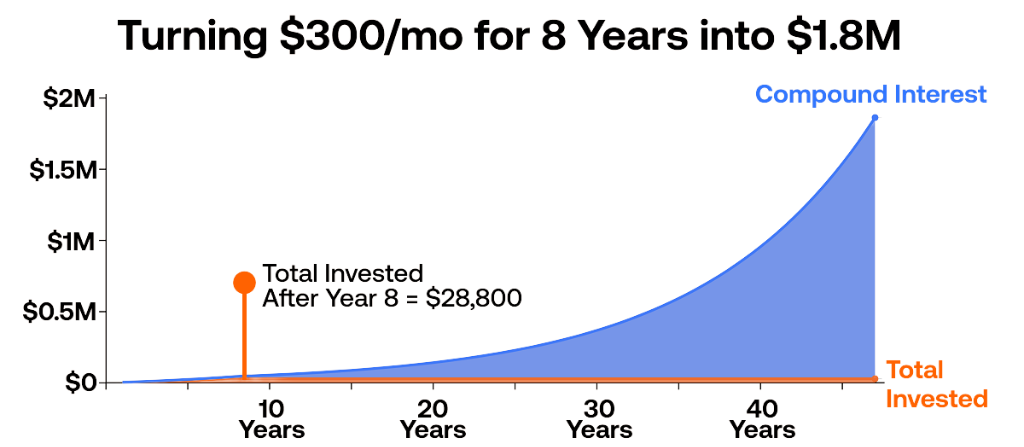
This concept illustrates how compound growth can increase the value of contributions over time. Starting earlier provides more time for both initial contributions and any accumulated growth to build over extended periods. 

Understanding the Difference Between Saving and Investing  

A key factor in long-term financial planning is understanding how different types of accounts and assets function. Standard savings accounts typically offer lower returns compared to certain market-based assets. Some individuals explore assets with historically higher long-term growth potential when considering different financial strategies. 

Lower-yield accounts may not keep pace with inflation, which can reduce purchasing power over time. When inflation outpaces interest earnings, the real value of savings may decline over time. To understand what it might take to reach a long-term target, such as the $1 million figure referenced by Northwestern Mutual as a benchmark for retirement planning, many discussions highlight asset categories that have historically outpaced inflation, such as:  

  • Index Funds & ETFs 
  • Stocks 
  • Real Estate (via REITs or Fractional Platforms) 
  • Cryptocurrency (e.g., Bitcoin) 
IRA Contribution Limits 

An Individual Retirement Account (IRA) is one type of account that individuals may use for long-term retirement saving, depending on their personal circumstances and goals. A monthly contribution of $300 equals $3,600 per year, an amount that falls within the IRS’s annual IRA contribution limits for many individuals. Certain types of IRAs offer tax-related features defined by IRS regulations, which can affect how investment growth is treated for tax purposes. Its contribution limits for the 2025 tax year are outlined as follows:  

Tax Year Investor Age Maximum Contribution Monthly Equivalent
2025 Under 50 $7,000 $583.33
2025 Age 50 or older $8,000 (Includes $1,000 catch-up) $666.67

Choosing the right type of IRA allows you to strategically hedge against future tax rates: 

IRA Type Tax Benefit Best Suited For
Traditional IRA Tax Deduction Now: Contributions may be tax-deductible in the year they are made, reducing your current taxable income. Investors who believe they are in a higher tax bracket today than they will be in retirement.
Roth IRA Tax-Free Growth Later: Contributions are made with after-tax dollars, but all growth and qualified withdrawals in retirement are 100% tax-free. Younger investors who expect to be in a higher tax bracket later in their careers or in retirement.
Diversification and the Role of a Modern Portfolio Mix  

While compound growth is one concept in long-term planning, diversification is often discussed as a way to spread exposure across different types of assets. Many market participants consider assets beyond traditional stocks and bonds when exploring different approaches to portfolio construction.   

Examples of asset types that are often mentioned in discussions of modern portfolio mixes include: 

Asset Category Role in Portfolio
Stocks & Index Funds High growth potential and long-term performance.
Bonds & Mutual Funds Stability, income generation, and risk mitigation.
Cryptocurrency A hedge against inflation and fiat devaluation.
Real Estate Tangible asset class; access via fractional platforms.
Alternative Assets Can hold value during market volatility.
Don’t Wait, Start Now and Diversify  

Long-term financial planning does not necessarily require high income or advanced expertise; many people focus on consistent habits and informed decision-making over time. A monthly contribution of $300, or a similar amount, can accumulate over long periods depending on market conditions and the type of account used.  

Concepts Often Discussed in Long-Term Financial Planning:  
  1. Start Early: Time is your most valuable asset and can provide more time for contributions to potentially grow. 
  2. Invest Consistently: Maintain that $300/month discipline. 
  3. Diversify Your Portfolio: Spread your risk and maximize growth opportunities. 
  4. Don’t Let Your Money Sit Idle: Instead of letting money sit idle, some people look for ways their capital might work over time.  

Ready to explore how an asset like Crypto can enhance your retirement strategy within a balanced portfolio? Open an account with BitcoinIRA¹ today and start building your diversified future. 


FAQs 

Is compound growth guaranteed? 
Investment returns are not guaranteed, and actual performance can vary based on market conditions and the specific assets involved. 

Is cryptocurrency considered suitable for retirement accounts? Cryptocurrencies can be volatile, and individuals evaluate them differently based on their own risk tolerance and financial goals. Some self-directed IRA providers, including BitcoinIRA, allow digital assets to be held within certain retirement account structures.  

Do contributions need to continue indefinitely?

Not always. Some long-term illustrations show how early contributions may grow over extended periods due to compounding. Actual outcomes vary, and individuals make decisions based on their own circumstances and goals.  


Found it interesting? Share the article to socials
  1. BitcoinIRA is a platform that connects consumers to qualified custodians, digital wallets and cryptocurrency exchanges. The company is not a custodian, is not a digital wallet and is not an exchange. The information provided in this article is for educational purposes only. We encourage you to consult a qualified tax or investment advisor to determine whether BitcoinIRA makes sense for you
  2. Security, storage, wallet providers, and insurance may vary based on asset chosen and custody solution available.
  3. Some taxes may apply. We recommend you consult your tax, legal or investment advisor.
  1. Bitcoin IRA is a platform that connects consumers to qualified custodians, digital wallets and cryptocurrency exchanges. The company is not a custodian, is not a digital wallet and is not an exchange. The information provided in this article is for educational purposes only. We encourage you to consult an adviser or professional to determine whether Bitcoin IRA makes sense for you.

  2. Security, storage, wallet providers, and insurance may vary based on asset chosen and custody solution available.

Continue reading

Getting Started - Crypto IRAs
|
07-17-2026
Take control of your retirement today

Trust America’s #1 Bitcoin IRA and invest in your future with revolutionary digital assets. Open an account and self-trade 24/7.