
Key Takeaways:
- On August 15, 1971, President Nixon ended the U.S. dollar’s direct convertibility to gold, triggering a shift to the fiat currency system.
- This “Nixon Shock” paved the way for decades of inflation, currency devaluation, and loss of monetary discipline.
- Gold, while a historic store of value, struggled to function as a practical day-to-day monetary standard in the modern economy.
- Bitcoin offers the scarcity of gold with the portability, divisibility, and digital nature needed for a global, modern monetary system.
Every August 15 marks the anniversary of one of the most significant monetary turning points in history, the Nixon Shock. In 1971, U.S. President Richard Nixon severed the last ties between the U.S. dollar and gold, ending the Bretton Woods system and placing the world fully on fiat money. This decision reshaped global finance, ushering in an era of floating exchange rates, persistent inflation, and cycles of monetary expansion.
Today, fifty-four years later, Bitcoin continues to solidify its role as “digital gold,” but with properties that make it more resistant to the weaknesses that limited gold’s role in the modern monetary system.
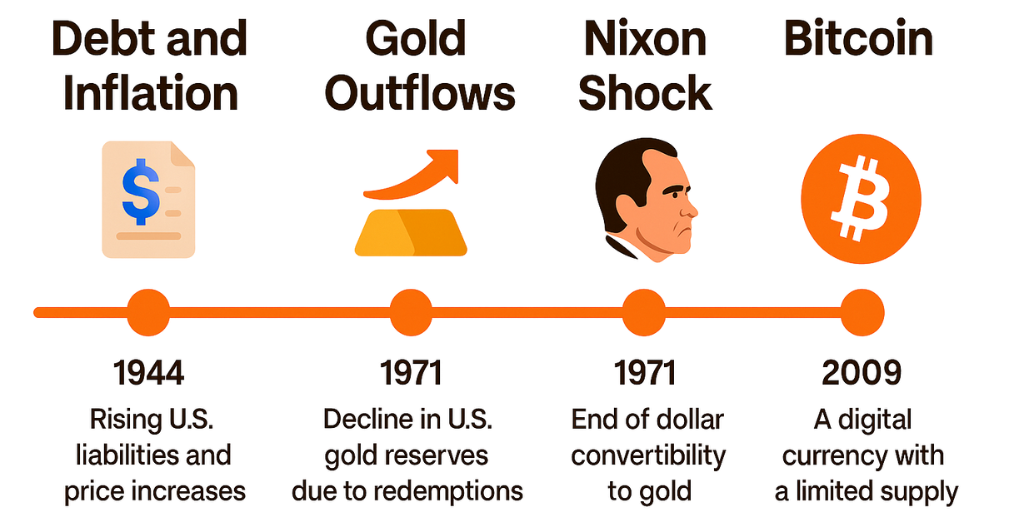
The Nixon Shock Explained
Before 1971, the U.S. dollar was pegged to gold at $35 per ounce under the Bretton Woods system, and other major currencies were pegged to the dollar. This framework aimed to provide global monetary stability after World War II.
By the late 1960s, however, massive government spending on the Vietnam War and domestic social programs, combined with trade deficits, caused the U.S. to print more dollars than it could back with gold. Foreign governments began demanding gold for their dollar reserves, threatening U.S. gold reserves.
On August 15, 1971, Nixon announced that the U.S. would “temporarily” suspend the dollar’s convertibility to gold. That “temporary” measure became permanent. The world moved to a fiat currency regime where money was no longer backed by a scarce, tangible asset, but by government decree alone.
The Effects: Inflation, Devaluation, and Debt
The Nixon Shock had profound and lasting consequences:
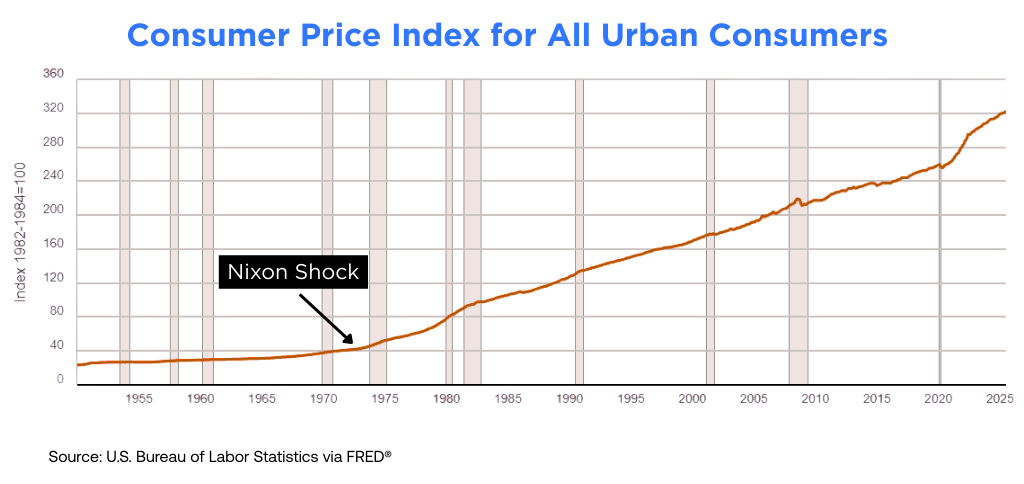
- Persistent inflation: Without the gold peg, governments could expand the money supply more freely, eroding purchasing power over time.
How Bitcoin Solves What Gold Couldn’t
Gold has historically been a trusted store of value, but as a monetary base in the modern world, it has limitations:
- Portability: Large quantities of gold are cumbersome to store, transport, and verify.
- Divisibility: Breaking gold into small, usable denominations is impractical.
- Integration with modern finance: Gold does not easily integrate into fast, digital transactions or global payment networks.
As economies became more digital and globalized, gold’s physical limitations made it impractical for everyday commerce, even though it retained value over time.

Bitcoin combines the scarcity of gold with the technological advantages of the digital era:
- Fixed supply: Bitcoin’s 21 million cap is enforced by code, not government promises.
- Portability: It can be sent anywhere in the world in minutes, with low storage costs.
- Divisibility: Bitcoin is divisible into 100 million satoshis, enabling microtransactions.
- Security and transparency: The blockchain allows public verification without central authority.
- Borderless and censorship-resistant: No government can unilaterally debase or seize it at the protocol level.
In effect, Bitcoin restores monetary discipline similar to a gold standard, but without the logistical and transactional limitations of physical gold.
Conclusion
The Nixon Shock of August 15, 1971 marked the end of gold-backed money and the start of an era where fiat currencies dominate. While gold tried to serve as a safeguard against currency debasement, it couldn’t adapt to the speed and scale of the modern global economy. Bitcoin, by contrast, is tailor-made for the digital age, combining scarcity with efficiency, divisibility, and portability.
For those seeking a hedge against inflation and a safeguard against the flaws of fiat currency, Bitcoin represents the next evolutionary step in sound money. Just as the Nixon Shock reshaped the financial world half a century ago, Bitcoin could define the next fifty years.
Start building your future with Bitcoin today. Open a BitcoinIRA¹ account and take control of your financial independence.
FAQs
What was the Nixon Shock?
It was President Nixon’s 1971 decision to end the dollar’s convertibility to gold, effectively ending the Bretton Woods system and starting the modern fiat currency era.
Why did Nixon end the gold standard?
The U.S. was running trade deficits and printing more dollars than it had gold reserves to back, prompting foreign governments to demand gold redemption and threatening U.S. gold supplies.
How did the Nixon Shock impact inflation?
Without the gold peg, governments could expand the money supply more easily, which contributed to higher and more persistent inflation rates.
Why is Bitcoin considered “digital gold”?
Like gold, Bitcoin has a fixed supply and acts as a store of value, but it is digital, more portable, and more easily divisible, making it better suited for the modern economy.










 3,500+ 5-Star Reviews