
Seventeen years ago, on October 31, 2008 as the global financial system reeled from an unprecedented crisis, a pseudonymous entity named Satoshi Nakamoto quietly published a document that would ignite a monetary revolution. Titled “Bitcoin: A Peer-to-Peer Electronic Cash System,” this nine-page white paper laid the groundwork for Bitcoin, a digital currency designed to operate without central banks or trusted intermediaries. Beyond its technical proposal, many interpret it as a statement of financial independence and decentralization.
The Problem Bitcoin Addressed: Trust in Traditional Financial Systems
Before Bitcoin, electronic payments fundamentally relied on trusted third parties like banks, Visa, or PayPal. These institutions processed transactions, offered fraud protection, and mediated disputes between parties. While convenient, this system came with significant drawbacks:
- Costs: Fees were necessary to cover the overhead of these intermediaries and the costs of fraud.
- Centralization: Centralized control created potential vulnerabilities including censorship, seizure risk, and single points of failure.
- Lack of Finality: Reversible transactions created uncertainty and increased business costs.
- The 2008 Crisis: The 2008 financial crisis underscored public concerns about transparency, centralization, and trust in established financial institutions.
Satoshi Nakamoto proposed an electronic cash system that enabled payments to be sent directly between parties without relying on a financial institution. The system relied on cryptographic proof rather than trust to verify transactions.
Core Concepts: The Pillars of a New Economy
The Bitcoin white paper introduced several innovative concepts designed to address the challenge of creating trustless digital cash:
1. The Double-Spending Problem & Its Elegant Solution
The biggest challenge for any digital currency is preventing “double-spending”, the risk that a user could spend the same digital unit twice, much like copying a file. Previous attempts to create digital cash failed to solve this without a central authority.
Satoshi Nakamoto proposed a distributed public ledger, now known as the blockchain, secured through a timestamp server and a Proof-of-Work (PoW) consensus mechanism. This system would create a chronological, tamper-resistant record of all transactions, visible to everyone on the network.
2. Blockchain Technology: A Tamper-Resistant Ledger
Imagine a digital ledger where every page (a “block”) is filled with transaction data. Once a page is full, it’s sealed and linked to the previous page with a cryptographic “chain,” creating an unbreakable sequence.
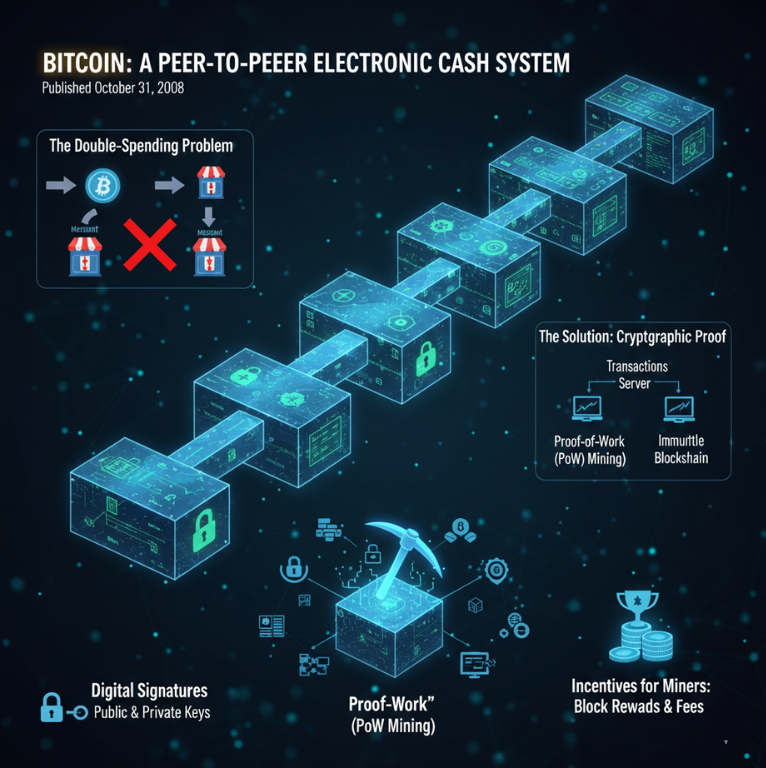
Each block contains a cryptographic hash of the previous block, timestamping the transactions and making it incredibly difficult to alter past records. Any attempt to tamper with a block would change its hash, invalidating all subsequent blocks and causing the alteration to be detected by the network through consensus verification.
3. Proof-of-Work: Securing the Network
Proof-of-Work is the mechanism that ensures only valid and honest additions are made to the blockchain ledger. In this system, miners compete to solve a complex computational puzzle. The first miner to solve the puzzle earns the right to add the next block of validated transactions to the blockchain.
This “work” requires significant computational power and energy, making it economically costly for any malicious participant to attempt manipulating the blockchain. To reverse a transaction, an attacker theoretically need to redo the Proof-of-Work for that block and all subsequent blocks faster than the rest of the honest network combined, an undertaking requiring control of more than 50% of the network’s total computational power, known as a “51% attack.” This economic disincentive is a primary factor that secures the Bitcoin network against manipulation.
Transaction and Network Mechanics
Beyond these core innovations, the white paper detailed the practical mechanics:
- Digital Signatures: Each user controls their bitcoin using a pair of cryptographic keys, a public key (comparable to an account number) and a private key (used to authorize transactions). Transactions are digitally signed with the private key, proving control over the associated funds and preventing unauthorized spending.
- Incentives for Miners: To maintain network security and participation, miners are rewarded for their computational work. When a miner successfully adds a block, they receive a block reward consisting of newly created bitcoins and any transaction fees from the included transactions. This reward structure provides an economic incentive for honest participation in the network.
- Pseudonymity: While every Bitcoin transaction is recorded on the public blockchain, the identities of the participants are not directly linked to their real-world names. Instead, transactions are associated with alphanumeric Bitcoin addresses, providing a limited degree of pseudonymity and privacy.
Impact and Legacy: Beyond a Digital Currency
The Bitcoin white paper not only introduced a new form of digital money but also inspired an industry-wide exploration of decentralized systems and new models of trust and value exchange.
- Birth of Blockchain Technology: Bitcoin introduced the world to blockchain, a technology now explored across sectors such as finance, supply chain management, and healthcare for its ability to create secure, transparent, and tamper-resistant records.
- Decentralization as an Ideal: Bitcoin championed the ideal of decentralization—a system where no single entity has control, fostering censorship resistance and permissionless innovation. This ethos continues to drive the broader cryptocurrency and Web3 movements.
- A Catalyst for Innovation: Bitcoin’s success sparked the creation of thousands of other cryptocurrencies and decentralized applications (dApps), each building upon or iterating on the foundational ideas presented in Satoshi’s paper.
Seventeen years after its publication, the Bitcoin white paper remains a foundational document in digital currency history, illustrating a novel cryptographic approach to solving the problem of trust in electronic transactions and continuing to influence technological and financial innovation.
Crypto IRAs: Integrating Digital Assets into Retirement Accounts
The ideas in the Bitcoin white paper led to the emergence of a new category of digital assets based on decentralized technology. Over time, Bitcoin and other cryptocurrencies have evolved from a technical experiment into a recognized component of the broader financial ecosystem.
In 2016, approximately eight years after the publication of Satoshi Nakamoto’s white paper, BitcoinIRA¹ was founded, becoming the first company to introduce a self-directed retirement account allowing cryptocurrency holdings. This development introduced a way for individuals to hold digital assets within certain self-directed retirement accounts, expanding the range of available retirement investment options.
The Power of a Crypto IRA
A Crypto IRA (Individual Retirement Account) is a type of self-directed IRA that allows you to hold assets like Bitcoin, Ethereum, and more cryptocurrencies within a traditional, tax-advantaged retirement structure, just as you would stocks or mutual funds. One key distinction between a Crypto IRA and regular crypto trading accounts is how potential tax obligations are structured:
- Tax Treatment of Transactions: In a standard brokerage account, cryptocurrency trades that result in profits are typically subject to capital gains taxes. Within certain IRA structures, digital asset transactions may receive tax-deferred or tax-exempt treatment, depending on the account type and applicable IRS regulations.
- Tax-Deferred vs. Tax-Free:
- Traditional Crypto IRA: Depending on IRS eligibility rules, contributions may be tax-deductible, and any gains are tax-deferred until withdrawals are made in retirement.
- Roth Crypto IRA: Contributions are made with after-tax dollars. If IRS conditions for qualified distributions are met, withdrawals in retirement, including any gains, are tax-free².
For individuals interested in the long-term applications of decentralized technology, a Crypto IRA provides a regulated framework to hold digital assets within a retirement account structure that offers potential tax advantages under existing IRS rules.
Secure Your Future: Open a BitcoinIRA Account Today!
Individuals interested in understanding how retirement accounts can include digital assets such as Bitcoin, Ethereum, and other supported cryptocurrencies can explore how these accounts are structured and regulated. BitcoinIRA offers a self-directed retirement account option that enables digital asset holdings within a tax-advantaged structure, consistent with applicable IRS guidelines.








 3,500+ 5-Star Reviews